Showing posts with label Science. Show all posts

Tuesday, September 20, 2011

Deep Secrets Of The Universe

1)

Brightest object in the universe


 Astromers have discovered ULAS J1120+0641,A quasar that existed when the universe was only 770 million years old,It has been titled as the brightest object ever found in the universe -because it took nearly 13 billion years for its light to reach the Earth.It is about 60 trillion times more brighter then our sun. (A trillion is 1 million millions.) ULAS J1120+0641 took the brightest object title from another quasar that wasn't formed until about 100 million years later, when the universe was 870 million years old.
"Since quasars are so luminous, they guide astronomers studying the conditions of the cosmos following the Big Bang, the explosion believed to have created the universe 13.7 billion years ago.

2)
Most massive black hole in the universe.
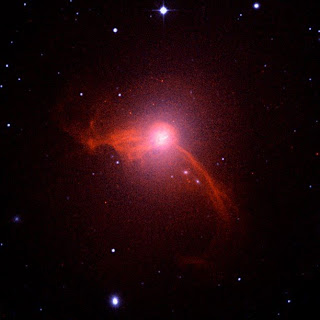

The black hole at the center of the supergiant elliptical galaxy M87 in cluster Virgo fifty million light-years away is the most massive black hole known so far -6.6 billion solar masses. Orbiting the galaxy is an abnormally large population of about 12,000 globular clusters, compared to 150-200 globular clusters orbiting the Milky Way.

It is vastly larger than the black hole at the center of our Milky Way, which is about 4 million solar masses. The black hole’s event horizon, 20 billion km across and could swallow our solar system whole.

In order to calculate the black hole’s mass, the astronomers measured how fast surrounding stars orbit the black hole. They found that, on average, the stars orbit at speeds of nearly 500 km/s (for comparison, the sun orbits the black hole at the center of the Milky Way at about 220 km/s). From these observations, the astronomers could come up with what they say is the most accurate estimate for the mass of a supermassive black hole.The team theorizes that the M87 black hole grew to its massive size by merging with several other black holes. M87 is the largest, most massive galaxy in the nearby universe, and is thought to have been formed by the merging of 100 or so smaller galaxies. The M87 black hole’s large size and relative proximity, the astronomers think that it could be the first black hole that they could actually “see.”

Future calculations may attempt to calculate the size of another black hole with a roughly estimated mass of 18 billion solar masses, which is located in a galaxy about 3.5 billion light-years away.

3)

Sunrise and sunset on mars


4)


This infrared image from NASA's Spitzer Space Telescope shows the Helix nebula, a cosmic starlet often photographed by amateur astronomers for its vivid colors and eerie resemblance to a giant eye.

The nebula, located about 700 light-years away in the constellation Aquarius, belongs to a class of objects called planetary nebulae. Discovered in the 18th century, these cosmic butterflies were named for their resemblance to gas-giant planets.

Planetary nebulae are actually the remains of stars that once looked a lot like our sun.
When sun-like stars die, they puff out their outer gaseous layers. These layers are heated by the hot core of the dead star, called a white dwarf, and shine with infrared and visible-light colors. Our own sun will blossom into a planetary nebula when it dies in about five billion years.

In Spitzer's infrared view of the Helix nebula, the eye looks more like that of a green monster's. Infrared light from the outer gaseous layers is represented in blues and greens. The white dwarf is visible as a tiny white dot in the center of the picture. The red color in the middle of the eye denotes the final layers of gas blown out when the star died.

The brighter red circle in the very center is the glow of a dusty disk circling the white dwarf (the disk itself is too small to be resolved). This dust, discovered by Spitzer's infrared heat-seeking vision, was most likely kicked up by comets that survived the death of their star. Before the star died, its comets and possibly planets would have orbited the star in an orderly fashion. But when the star blew off its outer layers, the icy bodies and outer planets would have been tossed about and into each other, resulting in an ongoing cosmic dust storm. Any inner planets in the system would have burned up or been swallowed as their dying star expanded.

The Helix nebula is one of only a few dead-star systems in which evidence for comet survivors has been found.

5)


 Hubble's deepest view-Everything you see in the above picture is a galaxy,it is the most detailed and deepest picture of the universe provided to mankind by hubble telescope.


Hubble captured several thousand never-before-seen galaxies, which were formed 600 million years after the Big Bang. The galaxies are about 13 billion light years away. Each light year is about 6 trillion miles.
The image was taken in a region of space that Hubble scanned in 2004. Since the new camera has a near-infared channel, it allows the orbiting telescope to peer deeper into the universe and spot distant galaxies.
The camera was installed in May by NASA spacewalking astronauts as part of a mission to upgrade and repair the aging telescope.
Hubble is a collaboration between NASA and the European Space Agency.

6)


Looking beyond the dust in the Milk Way, scientists have discovered 96 new star clusters. Using the world's largest survey telescope, scientists were able to snap infrared images of the clusters. Thirty of the new clusters are shown in this mosaic.

7)


The Lagoon Nebula (Messier 8, or M8) is a stellar nursery in the Milky Way that looks totally psychedelic. This striking image was captured using the Gemini South telescope in Chile and it reveals the chaotic environment in which new stars are born.

The nebula is sometimes called the 'Southern Cliff' because a sharp drop-off point is visible. Looking beyond the 'cliff,' you can see a formation of young stars shining in the upper left corner of the image.

8)

Baby pictures are usually adorable, but this one's out of this world - literally.

Astronomers have captured an image of what they believe to be a newly formed black hole, which resulted from a star that went supernova in 1979. Black holes are warped regions in space where it is so dense that nothing, not even light itself, can escape.

'If our interpretation is correct, this is the nearest example where the birth of a black hole has been observed,' said Daniel Patnaude, of the Harvard-Smithsonian Center for Astrophysics in Cambridge, Mass., who led the study.

9)


Solar Flares

10)
Beautiful nebula


11)


Is that a smashed comet or an X-Wing fighter?
Scientists are offering up their own theories as to what created the striking star-inspired image, which was captured by NASA's Hubble telescope.
"Two small and previously unknown asteroids recently collided, creating a shower of debris that is being swept back into a tail from the collision site by the pressure of sunlight," said principal investigator David Jewitt of the University of California at Los Angeles.
The object - dubbed “P/2010 A2” after it was discovered by the Lincoln Near-Earth Asteroid Research program sky survey - has traits similar to a comet, but the x-shape appears disconnected from the tail.
"The filamentary appearance of P/2010 A2 is different from anything seen in Hubble images of normal comets," Jewitt said.
Sci-fi lovers may instead go for a more fantastical theory, believing it to be the "Last Starfighter" or, perhaps, a Kilrathi dreadnought from the Wing Commander video game

12)

NASA's Hubble Space Telescope snapped this panoramic view of a colorful assortment of 100,000 stars residing in the crowded core of a giant star cluster. The image reveals a small region inside the massive globular cluster Omega Centauri, which boasts nearly 10 million stars.

13)

Rosette Nebula
14)

Bubble nebula(NGC 7635)

15)

Horsehead Nebula
16)

Ant Nebula(Menzel 3)
17)

Sombrero galaxy
18)
War of the galaxies

The collision between the two galaxies, which lie about 62 million light-years from Earth, started more than 100 million years ago and is still taking place.
19)
A beautiful composite image of the Milky Way centre using observations from the Hubble Space Telescope, the Spitzer Space Telescope, and the Chandra X-ray Observatory

20)

Astronomers have discovered the largest and oldest mass of water ever detected in the universe — a gigantic, 12-billion-year-old Cloud harboring 140 trillion times more water than all of Earth's oceans combined.
The cloud of water vapor surrounds a supermassive black hole called a quasar located 12 billion light-years from Earth. The discovery shows that water has been prevalent in the universe for nearly its entire existence, researchers said.
"Because the light we are seeing left this quasar more than 12 billion years ago, we are seeing water that was present only some 1.6 billion years after the beginning of the universe," said study co-author Alberto Bolatto, of the University of Maryland, in a statement. "This discovery pushes the detection of water one billion years closer to the Big Bang than any previous find."

21)

 Interesting...rite?

22)

Snapped by the Hubble Space Telescope, these images of Arp 273 are truly spectacular. Two galaxies are coming close to colliding because of powerful gravitational tides.

23)

Expansion of universe after big bang


24)

Biggest known star to mankind -vy canis majoris


Vy canis majoris is the largest star known to mankind.It is 2,100 times the size of the sun.Placed in our Solar System, its surface would extend out past the orbit of Saturn. Some astronomers disagree, and think that VY Canis Majoris might be smaller; merely 600 times the size of the Sun, extending past the orbit of Mars.That’s the biggest star that we know of, but the Milky way probably has dozens of stars that are even larger, obscured by gas and dust so we can’t see them.


25)


The Sloan Great Wall is a giant wall of galaxies (a galactic filament) and to the present day is the largest known structure in the universe. Its discovery was announced on October 20, 2003 by J. Richard Gott III of Princeton University and Mario Jurić and their colleagues, based on data from the Sloan Digital Sky Survey. The wall measures 1.37 billion light years (1.30×1025 m) in length, which is approximately 1/60 of the diameter of the observable universe, and is located approximately one billion light-years from Earth.


Thursday, September 8, 2011

Did we really land on the moon?


p.s:-The purpose of this article is to share fascinating and interesting conspiracy theories about the moon landing.There are significant number of people out there who believes that nasa actually faked the moon landing.I dont intend to say that we didnt land on the moon or we did,it's totally upto you to decide. :)

It has been more than 40 years since Neil Armstrong made that first step on the Moon. Yet, there are a few people who still ask, “Did we really land on the moon?”

There are those who spread conspiracy theories alleging that those Moon landings were all fake.

Was the moon landing fake ??? did we ever land on the moon ??
read this >>
1) When the astronauts are putting up the American flag it waves. There is no wind on the Moon.

2) No stars are visible in the pictures taken by the Apollo astronauts from the surface of the Moon.

3) No blast crater is visible in the pictures taken of the lunar landing module.

4) The landing module weighs 17 tons and yet sits on top of the sand making no impression. Next to it astronauts’ footprints can be seen in the sand.

5) The footprints in the fine lunar dust, with no moisture or atmosphere or strong gravity, are unexpectedly well preserved, as if made in wet sand.

6) When the landing module takes off from the Moon’s surface there is no visible flame from the rocket.

7) If you speed up the film of the astronauts walking on the Moon’s surface they look like they were filmed on Earth and slowed down.

8.) The astronauts could not have survived the trip because of exposure to radiation from the Van Allen radiation belt.

9) The rocks brought back from the Moon are identical to rocks collected by scientific expeditions to Antarctica.

10) All six Moon landings happened during the Nixon administration. No other national leader has claimed to have landed astronauts on the Moon, despite 40 years of rapid technological development.

11)The Moon's surface during the daytime is so hot that camera film would have melted.

12)Why hasn't nasa sent another spacecraft to the moon since 70's?The reason given is: lack of money.

13)One NASA picture from Apollo 11 is looking up at Neil Armstrong about to take his giant step for mankind. The photographer must have been lying on the planet surface. If Armstrong was the first man on the Moon, then who took the shot?


In 1968 NASA Chief Astronaut, Deke Slayton, (one of the main perpetrators of faking Apollo), visited the film set of "2001 Space Odyssey", in the UK He referred to it as NASA East, and it was here that he got the idea for filming the mock lunar module, and command module separation and docking. Film of the alleged booster stage falling away from module was also sequenced on Kubrick's film set. Think about it, how could you install a camera in the center part of a rocket booster engine without it being burned to a crisp? It can only be done on a film set, and why is it we only see this sequence, albeit repeated for each Apollo mission, only on the Moon missions, and not on any other space mission? TV pictures allegedly beamed back to Earth showing the lunar module separation, were razor sharp color images, why therefore were the TV transmissions from the Moon gray and fuzzy, after all they were supposedly transmitted across the same distance in space?

In Tim Furniss's book "One Small Step", there are numerous references to mechanical, electrical, and other problematic failures in practically EVERY Gemini and Apollo mission. It's unbelievable that the USA ever got into space at all, let alone to the Moon and back, which of course they did not. Many NASA space problems and failures continued long after the Apollo program, and still continue today. If NASA could achieve such amazing feats 42 years ago, then space technology has gone backwards instead of forward.
However, only 2 years later, American President John F. Kennedy set a goal in May 1961, when he made the following famous speech. 'I believe that this nation should commit itself. To achieving the goal, before this decade is out, of landing a man on the Moon and returning him safely to the Earth. No single space project in this period will be more impressive to mankind or more important for the long range exploration of Space.' It was just eight years later in 1969, that man finally left Earth and set foot on the Moon... Or so we have been led to believe.

In western Australia during the live broadcast of the Apollo 11 moon landing, several people saw a very unusual occurrence. One viewer, Una Ronald watched the telecast and was astonished with what she saw.

The residents of Honeysuckle Creek, Australia, actually saw a different broadcast to the rest of the World. Just shortly before Armstrong stepped onto the Moons surface, a change could be seen where the picture goes from a stark black to a brighter picture. Honeysuckle Creek stayed with the picture and although the voice transmissions were broadcast from Goldstone, the actual film footage was broadcast from Australia. As Una watched Armstrong walking on the surface of the Moon she spotted a Coke bottle that was kicked in the right hand side of the picture. This was in the early hours of the morning and she phoned her friends to see if they had seen the same thing, unfortunately they had missed it but were going to watch the rebroadcast the next day. Needless to say, the footage had been edited and the offending Coke bottle had been cut out of the film. But several other viewers had seen the bottle and many articles appeared in The West Australian newspaper.

Western Australia received their coverage in a different way to the rest of the World. They were the only Country where there wasn't a delay to the 'live' transmission. Bill Kaysing says 'NASA and other connected agencies couldn't get to the Moon and back and so went to ARPA (Advanced Research Projects Agency) in Massachusetts and asked them how they could simulate the actual landing and space walks. We have to remember that all communications with Apollo were run and monitored by NASA, and therefore journalists who thought they were hearing men on the Moon could have easily been misled. All NASA footage was actually filmed off TV screens at Houston Mission Control for the TV coverage... No one in the media were given the raw footage.

So why Would nasa fake it?
One of the major reasons believed for it is The Space Race.
The US government deemed it vital that it win the Space Race against the Soviet Union. Going to the Moon would be risky and expensive, as exemplified by John F. Kennedy famously stating that the United States chose to go because it was hard.


Since most conspiracists believe that sending men to the Moon was impossible at the time, they argue that landings had to be faked to fulfill President Kennedy's 1961 promise: "achieving the goal, before this decade is out, of landing a man on the Moon and returning him safely to the Earth". Others have claimed that, with all the known and unknown hazards, NASA would not have risked the public humiliation of astronauts crashing to their deaths on the lunar surface, broadcast on live TV.


Sunday, August 28, 2011

The World's First Fully Sustainable,Zero-Carbon,Zero-Waste City.-Masdar.


Masdar  is an ecological project in Abu Dhabi, in the United Arab Emirates.It will be the world's first carbon neutral, zero waste and fully sustainable city.The project is headed by the Abu Dhabi Future Energy Company (ADFEC).Started in 2006, the project will cost US$22 billion and take about eight years to build(first phase).Final completion is scheduled to occur between 2020 and 2025.


 The city will rely entirely on solar energy and other renewable energy sources, with a sustainable, zero-carbon, zero-waste ecology.A multitude of green technologies will be utilised - including a solar power plant, rooftop photovoltaics, wind farms, geothermal sources and a hydrogen power plant. The city's water needs will be fulfilled by a solar-powered desalination plant. 


Automobiles will be banned within the city; travel will be accomplished via public mass transit and personal rapid transit systems, with existing road and railways connecting to other locations outside the city

Saturday, August 13, 2011

The green wall of china to be completed in 2074.


The Green Wall of China is the greatest and biggest ecological project in the human history .Under the project about  4,480km (2,800 mile) long shelterbelt of trees will be planted across the republic of china to stop the expansion of the gobi desert.It will be completed around 2074.

So why is the green wall of china being built?


Each spring, the dust from China's northern deserts is swept up by the wind and whipped eastward, blasting into Beijing. A choking blanket of particles coats houses, cars, and people, and the city's hospitals become flooded with patients suffering from respiratory ailments. The dust clogs machinery, shutters airports, and destroys crops, forcing thousands of rural Chinese off their lands. Clouds of it blow throughout Asia, carrying pollution and potentially infectious disease. In Korea, the government recently considered declaring the dust storms a natural disaster.
The Green Wall project was begun in 1978.As of 2009 China’s planted forest covered more than 500,000 square kilometers (increasing tree cover from 12% to 18%) – the largest artificial forest in the world.However, of the 53,000 hectares planted, a quarter has died and of the remaining many are dwarf trees, which lack the capacity to protect the soil. In 2008 winter storms destroyed 10% of the new forest stock, causing the World Bank to advise China to focus more on quality rather than quantity in its stock species


Friday, August 12, 2011

Nanotechnology Will Make Us Immortal In Next 20-30 Years.


Yes U read it right!!!.Nanotechnology will make us immortal in coming future.That may sound like something out of a sci-fi movie, but research well underway today is leading to a time when a combination of nanotechnology and biotechnology will wipe out cancer, Alzheimer's disease, obesity, diabetes and many other incurable diseases.

How will Nanotechnology make us immortal?

  
Ray Kurzweil,a a member of the Inventor's Hall of Fame and a recipient of the National Medal of Technology and a futuristic scientist has predicted that man could become immortal in as little as 20 years' time through nanotechnology and better understanding of the body mechanism. Although whether it can be acheived in mere 20 years is debatable,Many scientists have started to believe that immortality will no longer be a dream in near future.

The scientist says that already, blood cell-sized submarines called nanobots are being tested in animals. These will soon be used to destroy tumours, unblock clots and perform operations without scars and ultimately slow aging.Finally, nanobots will replace blood cells and do their work thousands of times more effectively.

The full realization of nanobots will basically eliminate biological disease and aging. I think we'll see widespread use in 20 years of [nanotech] devices that perform certain functions for us. In 30 or 40 years, we will overcome disease and aging. The nanobots will scout out organs and cells that need repairs and simply fix them. It will lead to profound extensions of our health and longevity."


Nanotechnology will cure cancer.
 Earlier this year, scientists at the University of London reported using nanotechnology to blast cancer cells in mice with "tumor busting" genes, giving new hope to patients with incurable tumors. So far, tests have shown that the new technique leaves healthy cells undamaged.

Nanotechnology Will make Us immortal,Not Invincible.
 
Obviously, the use of nanotechnology cannot make us invincible – so there certainly would still be many deaths from accidental trauma, violence, suicide and other such avenues.

Few Problems that can arise if we become immortal
  •  The population explosion will quite clearly be a massive cause for concern.  
  • Imagine competing for a job interview with a person who has atleast 150 years of experience :P =))
  • Prisoners who are sentenced 2-3 years of jail  would have no effect of it if they can live as long as 500 years or more.
  • Food and Water Crisis.
Check out my previous post on picotechnology and femtotechnology :) ...its fascinating and interesting..!!!! :D


What is Picotechnology/femtotechnology?

Picotechnology is a future Technology on the scale of trillionths of a metre (10-12) This is orders of magnitude smaller than the nanotechnology.This technology is a future technology,and humans will achieve it in 22nd century.

Applications of picotechnology

The structure and properties of individual atoms can be altered via the manipulation of energy states within electrons, to produce metastable states with highly unusual properties, creating new forms of exotic atoms.The Current efforts in research are centered on support for the furthering of nanotechnology.While nanotechnology will certainly help us on earth,easing pressure on strained resources,increasing intelligence and creating infinite health.The True Magic of the future will come from deep inside the pico and femto world.(Femtotechnology is a technology on the scale of 10-15m ).

Discoveries  such as endless supply of non-polluting energy,faster than lighttravel,teleportation,timetravel,mind to mind transfer of knowledge and inventions we cant even imagine are all within this area of research.

Monday, August 8, 2011

Stephen Hawking-Biography


Birth and Early life

Stephen William Hawking was born on january 8th 1942 in oxford,london,which is exactly 300 years after the death of Galileo. From a very early age Hawking showed the qualities of a scientist, he was always inquisitive. He liked to build models to see how things worked.He is a theoretical physicist and cosmologist, whose scientific books have made him an academic celebrity.He is probably one of the most famous cosmologists and theoretical physicists alive.

School

Hawking went to the High School for Girls (yes, the school was supposed to be for girls) at St. Albans at the age of 8. Later, he switched to St. Albans School by passing the eleven-plus examination. Hawking was a keen child, but he was not the brightest in his competitive A stream class. Some of his classmates did not believe he could do well, though they gave him the nickname of Einstein.

College Life

Hawking's father who was a doctor, wanted him to study medicine at Oxford. However, he was more interested in Mathematics. It turned out that he studied Physics, as the University College did not provide degree studies in Mathematics

At the age of 20, Hawking went on to do research in Cosmology at Cambridge. This was also about the time when he was diagnosed with the incurable disease ALS (Amyotrophic Lateral Sclerosis). He slowly lost control of his muscles and was told would die within a few years. At first, Hawking was shocked and upset. He could not find a reason for living before he met his wife Jane Wilde. Later the progress of his illness slowed down, and he finished his Ph.D.

What made stephen hawking so famous?

Hawking is an example of the "cult of personality".
He was a brilliant young man, but it was his handicap that drew so many people to his side. It just seems amazing (to people who aren't handicapped) that he could accomplish ANYTHING with the constraints of his disease.

Hawking basically set out to prove that energy in the Universe could be created or destroyed, which flies in the face of everything we know. A few years ago, he modified his position, saying that the energy actually comes from or disappears into parallel universes.

His work in astrophysics has resulted in several breakthroughs in our knowledge of the universe, most notably his work on black holes

He grew to fame by writing "A Brief History of Time".

In 2009 stephen hawking was awarded the Presidential Medal of Freedom, the highest civilian award in the United States.


Stephen Hawking's thoughts on afterlife

According to Stephen hawking:"There is no heaven,it's a fairy story".A belief that heaven or an afterlife awaits us is a "fairy story" for people afraid of death-stephen hawking said.

He rejected the idea of life beyond death and emphasised, what he described as the need to fulfil our potential on Earth by making good use of our lives.

His works/books:-

A Brief History of Time
 Black Holes and Baby Universes and Other Essays
 The Universe in a Nutshell
 On The Shoulders of Giants. The Great Works of Physics and Astronomy
 A Briefer History of Time,
 The Grand Design

Tuesday, August 2, 2011

Are we alone in the universe???


HAVE you ever looked up at the night sky and wondered if somebody, or something, is looking back? If perhaps somewhere out there, the mysterious spark we call life has flickered into existence?

Intuitively, it feels as if we can't be alone. For every one of the 2000 stars you can see with your naked eye, there are another 50 million in our galaxy, which is one of 100 billion galaxies. In other words, the star we orbit is just one of 10,000 billion billion in the cosmos. Surely there is another blue dot out there - a home to intelligent life like us? The simple fact is, we don't know.

One way to estimate the number of intelligent civilisations was devised by astronomer Frank Drake. His equation takes into account the rate of star formation, the fraction of those stars with planets and the likelihood that life, intelligent life, and intelligent creatures capable of communicating with us, will arise.

It is now possible to put numbers on some of those factors. We know that about 20 stars are born in the Milky Way every year and we have spotted more than 560 planets around stars other than the sun. About a quarter of stars harbour a planet similar in mass to Earth
But estimating the biological factors is little more than guesswork. We know that life is incredibly adaptable once it emerges, but not how good it is at getting started in the first place.

Unique planet

Some astronomers believe life is almost inevitable on any habitable planet. Others suspect simple life is common, but intelligent life exceedingly rare. A few believe that our planet is unique. "Life may or may not form easily," says physicist Paul Davies of Arizona State University in Tempe. "We're completely in the dark."

So much for equations. What about evidence? Finding life on Mars probably won't help, as it would very likely share its origin with Earthlings. "Impacts have undoubtedly conveyed microorganisms back and forth," says Davies. "Mars and Earth are not independent ecosystems."

Discovering life on Titan would be more revealing. Titan is the only other place in the solar system with liquid on its surface - albeit lakes of ethane. "We are starting to think that if there is life on Titan it would have a separate origin," says Dirk Schulze-Makuch at Washington State University in Pullman. "If we can find a separate origin we can say 'OK, there's a lot of life in the universe'."

Discovering alien microbes in our solar system would be some sort of proof that we are not alone, but what we really want to know is whether there is another intelligence out there. For 50 years astronomers have swept the skies with radio telescopes for any hint of a message. So far, nothing.

But that doesn't mean ET isn't there. It just might not know we're here. The only evidence of our existence that reaches beyond the solar system are radio signals and light from our cities. "We've only been broadcasting powerful radio signals since the second world war," says Seth Shostak of the SETI Institute in Mountain View, California. So our calling card has leaked just 70 light years into space, a drop in the ocean. If the Milky Way was the size of London and Earth was at the base of Nelson's Column, our radio signals would still not have left Trafalgar Square.
"It's probably safe to say that even if the local galaxy is choc-a-bloc with aliens, none of them know that Homo sapiens is here," says Shostak. That also works in reverse. Given the size of the universe and the speed of light, most stars and planets are simply out of range.

It is also possible that intelligent life is separated from us by time. After all, human intelligence has only existed for a minuscule fraction of Earth's history and may just be a fleeting phase (see "Existence: Will we die out? "). It may be too much of a stretch to hope that a nearby planet not only harbours intelligent life, but that it does so right now.
But let's say we did make contact with aliens. How would we react? NASA has plans, and most religions claim they would be able to absorb the idea, but the bottom line is we won't know until it happens.

Most likely we'll never find out. Even if Earth is not the only planet with intelligent life, we appear destined to live out our entire existence as if it were - but with a nagging feeling that it can't be. How's that for existential
uncertainty?


Do we really exist or are we just a hologram?


TAKE a look around you. The walls, the chair you're sitting in, your own body - they all seem real and solid. Yet there is a possibility that everything we see in the universe - including you and me - may be nothing more than a hologram.

It sounds preposterous, yet there is already some evidence that it may be true, and we could know for sure within a couple of years. If it does turn out to be the case, it would turn our common-sense conception of reality inside out.
The idea has a long history, stemming from an apparent paradox posed by Stephen Hawking's work in the 1970s. He discovered that black holes slowly radiate their mass away. This Hawking radiation appears to carry no information, however, raising the question of what happens to the information that described the original star once the black hole evaporates. It is a cornerstone of physics that information cannot be destroyed.

In 1972 Jacob Bekenstein at the Hebrew University of Jerusalem, Israel, showed that the information content of a black hole is proportional to the two-dimensional surface area of its event horizon - the point-of-no-return for in-falling light or matter. Later, string theorists managed to show how the original star's information could be encoded in tiny lumps and bumps on the event horizon, which would then imprint it on the Hawking radiation departing the black hole.

This solved the paradox, but theoretical physicists Leonard Susskind and Gerard 't Hooft decided to take the idea a step further: if a three-dimensional star could be encoded on a black hole's 2D event horizon, maybe the same could be true of the whole universe. The universe does, after all, have a horizon 42 billion light years away, beyond which point light would not have had time to reach us since the big bang. Susskind and 't Hooft suggested that this 2D "surface" may encode the entire 3D universe that we experience - much like the 3D hologram that is projected from your credit card.
It sounds crazy, but we have already seen a sign that it may be true. Theoretical physicists have long suspected that space-time is pixelated, or grainy. Since a 2D surface cannot store sufficient information to render a 3D object perfectly, these pixels would be bigger in a hologram. "Being in the [holographic] universe is like being in a 3D movie," says Craig Hogan of Fermilab in Batavia, Illinois. "On a large scale, it looks smooth and three-dimensional, but if you get close to the screen, you can tell that it is flat and pixelated."

Quantum fluctuation

Hogan recently looked at readings from an exquisitely sensitive motion-detector in Hanover, Germany, which was built to detect gravitational waves - ripples in the fabric of space-time. The GEO600 experiment has yet to find one, but in 2008 an unexpected jitter left the team scratching their heads, until Hogan suggested that it might arise from "quantum fluctuations" due to the graininess of space-time. By rights, these should be far too small to detect, so the fact that they are big enough to show up on GEO600's readings is tentative supporting evidence that the universe really is a hologram, he says.

Bekenstein is cautious: "The holographic idea is only a hypothesis, supported by some special cases." Better evidence may come from a dedicated instrument being built at Fermilab, which Hogan expects to be up and running within a couple of years.

A positive result would challenge every assumption we have about the world we live in. It would show that everything is a projection of something occurring on a flat surface billions of light years away from where we perceive ourselves to be. As yet we have no idea what that "something" might be, or how it could manifest itself as a world in which we can do the school run or catch a movie at the cinema. Maybe it would make no difference to the way we live our lives, but somehow I doubt it.

Wednesday, July 27, 2011

Dark Matter

When the Universe was young, it was nearly smooth and featureless. As it grew older and developed, it became organized. We know that our solar system is organized into planets (including the Earth!) orbiting around the Sun. On a scale much larger than the solar system (about 100 million times larger!), stars collect themselves into galaxies. Our Sun is an average star in an average galaxy called the Milky Way. The Milky Way contains about 100 billion stars. Yes, that's 100,000,000,000 stars! On still larger scales, individual galaxies are concentrated into groups, or what astronomers call clusters of galaxies.


Hot X-ray gas in a cluster of galaxies
An overlay of an optical image of a cluster of galaxies
with an x-ray image of hot gas lying within the cluster

The cluster includes the galaxies and any material which is in the space between the galaxies. The force, or glue, that holds the cluster together is gravity -- the mutual attraction of everything in the Universe for everything else. The space between galaxies in clusters is filled with a hot gas. In fact, the gas is so hot (tens of millions of degrees!) that it shines in X-rays instead of visible light. In the image above, the hot X-ray gas (shown in pink) lying between the galaxies is superimposed on an an optical picture of the cluster of galaxies. By studying the distribution and temperature of the hot gas we can measure how much it is being squeezed by the force of gravity from all the material in the cluster. This allows scientists to determine how much total material (matter) there is in that part of space.
Remarkably, it turns out there is five times more material in clusters of galaxies than we would expect from the galaxies and hot gas we can see. Most of the stuff in clusters of galaxies is invisible and, since these are the largest structures in the Universe held together by gravity, scientists then conclude that most of the matter in the entire Universe is invisible. This invisible stuff is called 'dark matter', a term initially coined by Fritz Zwicky who discovered evidence for missing mass in galaxies in the 1930s. There is currently much ongoing research by scientists attempting to discover exactly what this dark matter is, how much there is, and what effect it may have on the future of the Universe as a whole.


In simple words:-The normal matter is one which interacts with the other normal matter and hence we can see/feel thair presence or can measure/observe their presence. Whereas the dark matter is that type of matter/particles which do not interact with particles of the normal matter as such we can not observe them directly. But its presence can be felt by the force of gravity it exerts on other matter/ light.

[Read: Are We Alone In The Universe?]
[Read: What Are Black Holes?]

What are black holes?


A black hole is a region of space from which nothing, not even light, can escape.A black hole is a super dense object that has an intense gravitational pull. There are two parts to a black hole, a singularity and a event horizon. If you were to take a slice of a black hole right through its center it would look like this:


    The event horizon is where the force of gravity becomes so strong that even light is pulled into the black hole. Although the event horizon is part of a black hole, it is not a tangible object. If you were to fall into a black hole, it would be impossible for you to know when you hit the event horizon. 
 
    The singularity is not really a tangible object either. According to the General Theory of Relativity the Singularity is a point of infinite space time curvature. This means that the force of gravity has become infinitely strong at the center of a black hole. Everything that falls into a black hole by passing the event horizon, including light, will eventually reach the singularity of a black hole. Before something reaches the singularity it is torn apart by intense gravitational forces. Even the atoms themselves are torn apart by the gravitational forces.
It is called "black" because it absorbs all the light that hits the horizon, reflecting nothing, just like a perfect black body in thermodynamics.

How Are Black Holes Formed?

The theory of general relativity predicts that a sufficiently compact mass will deform spacetime to form a black hole. 

Imagine a star which is much more massive than our sun, and which has a mass, called the critical mass, which is large enough to cause a black hole to form. What keeps this star from collapsing onto itself and becoming a black hole? The answer is that there is an intense pressure caused by nuclear reactions within the sun. When the fuel that feeds the nuclear reactions gets used up the massive star cannot support itself anymore. It then collapses to form a black hole.


It is interesting to note that when a black hole is formed by a collapsing star it is actually impossible to watch the final steps of the formation of the black hole from a stationary external reference frame. An external reference frame is a place where one watches the formation of the black hole from far away, like an astronomer on Earth. In addition, it is impossible to see any object fall into a black hole. This is not to say that everything appears to freeze just before entering a black hole. As an object falls into a black hole it gets increasingly dimmer and dimmer from the point of view of an outside observer. By the time an object gets to the edge of a black hole, it will be completely black. This effect, called a gravitational redshift, is caused by the immense gravity near the outside of a black hole.
 
 Evidence For the existence of black holes

This is an interesting problem. How do you prove the existence of something that cannot be observed by definition? Considering the exotic nature of black holes, it may be natural to question if such bizarre objects could exist in nature or to suggest that they are merely pathological solutions to Einstein's equations. Einstein himself wrongly thought that black holes would not form, because he held that the angular momentum of collapsing particles would stabilize their motion at some radius. This led the general relativity community to dismiss all results to the contrary for many years. However, a minority of relativists continued to contend that black holes were physical objects, and by the end of the 1960s, they had persuaded the majority of researchers in the field that there is no obstacle to forming an event horizon. 

There are actually many methods used to see if black holes really exist in our universe. The first method is to look for objects in our universe that have a lot of mass, but are very small. For example we can prove that there exists a black hole in an astronomical object called M87. This object weighs three billion times more than our sun, but takes up a volume no larger than our solar system.

  Another method of finding black holes is to look for an acceleration of matter. Since black holes have such strong gravitational fields, they accelerate anything that gets near them to great speeds. Rapid acceleration of an object can be observed by looking for doppler shifts in the light given off by an accelerating object. 

( Explanation: This artistic image is actually the signature of a supermassive black hole in the center of distant galaxy M84 - based on data recently recorded by Hubble's new Space Telescope Imaging Spectrograph (STIS). Very near black holes the force of gravity is so strong that even light can not escape ... but the presence of a black hole can also be revealed by watching matter fall into it. In fact, material spiraling into a black hole would find its speed increasing at a drastic rate. These extreme velocity increases provide a "signature" of the black hole's presence. STIS relies on the Doppler effect to measure gas velocity rapidly increasing to nearly 240 miles per second within 26 light years of the center of M84, a galaxy in the Virgo Cluster about 50 million light years away. The STIS data show that radiation from approaching gas, shifted to blue wavelengths left of the centerline, is suddenly redshifted to the right of center indicating a rapidly rotating disk of material near the galactic nucleus. The resulting sharp S-shape is effectively the signature of a black holes estimated to contain at least 300 million solar masses. Do all galaxies have central black holes? )  

Cool Things About Black Hole 

First of all, if you get close enough to a black hole you will see the back of your own head! This effect, called an Einstein ring, is caused by the intense gravity around a black hole. When you are near a black hole at certain distances the light that leaves from the back of your head will travel though space that is bent so much by gravity that it will enter your eyes. 

Another cool thing about black holes is that they might be able to destroy information. The destruction of    information is not allowed by quantum mechanics, so Hawking concludes that the usual rules of quantum mechanics cannot apply for black holes.
 

  Black holes aren’t always dangerous.


Having said that, let me ask you a question: if I were to take the Sun and replace it with  a black hole of the exact same mass, what would happen? Would the Earth fall in, be flung away, or just orbit like it always does?
Most people think the Earth would fall in, sucked inexorably down by the black hole’s powerful gravity. But remember, the gravity you feel from an object depends on the mass of the object and your distance from it. I said the black hole has the same mass as the Sun, remember? And the Earth’s distance hasn’t changed. So the gravity we’d feel from here, 150 million kilometers away, would be exactly the same! So the Earth would orbit the solar black hole just as nicely as it orbits the Sun now.Of course, we’d freeze to death. You can’t have everything.


The nearest black hole is 1,600 light years away. That is about 16 quadrillion kilometers for Earth.
There is a super massive black hole at the center of the Milky Way galaxy. It weighs in at about 4 million solar masses. Luckily, there is no reason to worry. This giant sucker is over 30,000 light years away.

Time Travel through Blackholes??

The idea that spaceships might zip across the universe using black holes as a high-speed portal is a well-worn sci-fi cliché.

But the consensus among scientists of late is that black holes are so destructive, spaceships would be torn to subatomic bits if they tried such a thing.And moreover if time travel was  possible why don't we have visitors from the future?.well there maybe,its just something that we dont know of.

Then again, maybe not. A new paper by University of Utah physicist Lior Burko, building on earlier work, raises the possibility that black holes may not annihilate everything, and that the potential for hyperspace travel is still open.

"One possibility is that black holes may allow us to travel to very remote places in the universe, or another universe entirely," said Burko in a telephone interview from his office in Salt Lake City. "It depends on the topology of the universe, which we do not know very well.... I'm not arguing it's a practical thing to do, but maybe in 1,000 years from now, maybe it would be simpler."

In Burko's scheme, black holes may be doorways to wormholes, theoretical constructs equivalent to tunnels, or shortcuts, between distant points of the universe, different points in time or even parallel universes.
Burko's ideas aren't new. Wormholes were popularized by Caltech physicist Kip Thorne in the 1980s, and were the interstellar vehicle of choice in Carl Sagan's influential novel Contact.

 
But subsequent black hole studies have suggested it would be impossible to use them as wormhole portals. The interiors of black holes are so infinitely dense that they exert massively destructive, "tide-like" distortions on approaching objects, ripping them into their constituent subatomic particles.
In fact, this infinitely dense interior gives black holes their potential for space and time travel. Inside a black hole, the very fabric of the universe is collapsed into a point of infinite curvature -- known as a "space-time singularity," where the laws of physics no longer apply.

However, Burko, a 34-year-old physicist from Israel, has suggested that some black holes may not be as destructive as others. Under certain circumstances, black holes may have "Cauchy horizon singularities," which may not be destructive but still act as openings to a wormhole.

Earlier work by Burko and others suggested weaker singularities were present in rotating black holes.
In a paper published in the March 28 issue of Physical Review Letters, Burko suggests that under certain conditions, hybrid singularities may exist. These hybrid singularities are composed of a strong sector, which is destructive, and a weak sector, which may not be. Any spacecraft entering the weak sector could possibly pass through without being damaged.

It's all theoretical, but the possibility of a weaker singularity doesn't rule out the potential of using black holes for interstellar travel.

"At the moment, we don’t have compelling evidence that this kind of hyperspace travel is disallowed," said Burko. "It doesn't mean, of course, it is allowed, but we don’t have compelling evidence to the contrary."
Princeton physicist Richard Gott, author of Time Travel in Einstein's Universe, said he hadn't read Burko's latest paper, but previous work on the subject reopened some interesting possibilities.
"It's certainly one of the possibilities that you can have a weak singularity," he said. "I characterize it like a speed bump. You hit it, and you come out in a new region. It could be a region of time travel, another universe or somewhere a great distance away. These are interesting possibilities and should be investigated further."

Burko noted that the theory rests on some unproven assumptions, and further work could debunk it. In addition, he said so little is known about quantum gravity -- the marriage of quantum physics and classic theories of gravity -- that as-yet-undiscovered laws may forbid hyperspace travel altogether.
Even if the idea of interstellar space travel through black holes is possible, traveling to a suitable black hole to try it out would be a problem.
Burko said the black hole at the center of the Milky Way may be a candidate, but it's 26,000-30,000 light years away. Traveling at near the speed of light -- the upper limit for an interstellar excursion -- the trip would take nearly 30,000 years.